JBoss EAP 7 Beta – Open Source Pioneer

There are a few Open Source technologies and products that have spearheaded the drive of Open Source  into the enterprise and managed to overcome historical objections  – Linux, Apache Web Server, MySQL, Postgres, WordPress, Hadoop, to name some of the better known technologies. Those technologies paved the way for the open source revolution of the last decade; every enterprise vendor and every organization has adopted open source to some degree. Open Source has won; get over it.

I think Red Hat’s JBoss EAP  (upstream WildFly , previously JBoss AS) is one of those pioneering technologies. It’s hasn’t merely broken through into the enterprise but broken into a strategically important segment that was previously dominated by tech. giants such as Oracle and IBM. It was a segment serviced by Mainframes, Transaction Processing Monitors, Object Request Brokers and highly proprietary 4GLs. As a side note – those same companies are still peddling proprietary products and technologies to solve those same problems.

Building on the early success of Java SE, Java EE was introduced back in 1999 as a collaboration between Sun Microsystems, Oracle and IBM. It was designed as an Open Standard platform for creating complex business applications. At the time, the unlikely collaborators all had a common enemy – Microsoft  – who had spent the last 15 years dominating the desktop with their brand of proprietary technology and were starting to make inroads into the data center. How times have changed.

The excitement around Java, the Open collaboration (through the JCP) and the large ecosystem of vendors supporting the standard helped Java EE dislodge previous generations of technology and contained Microsoft’s advances (.NET and it’s precursor DCOM) on it’s own Microsoft only island.

For the last fifteen years, Java EE has been  technology of choice for enterprises building scalable, reliable, sophisticated, typically business-critical applications and services. It’s proven to be one of the most important and long-lasting computing standards in our industry’s history – it’s hard (and a little painful) to imagine where we would be without it.

JBoss EAP (even before the Red Hat acquisition) was a market leader (as defined by industry analysts such as Gartner) and even today has continued its leadership position into new segments. It has lead many of the trends such as the original highly modular micro-kernel design (EAP 4 & 5), cloud-deployment, extensible module system, programmable management APIs, and first-class support for modern development tools like Maven and Git (EAP 6). That focus on bleeding-edge design has ensured that  JBoss EAP has always been ready to adapt to new architectures, deployment models and development practices. That is no less true today than it was ten years ago.

Today, IT organizations face many challenges – not least is the expectation that they can maintain large complex, intertwined application portfolios yet operate with the speed, efficiency and agility of web companies like Amazon, Netflix and Google. Unfortunately, few companies have the luxury of abandoning their existing applications to rewrite them as cloud-native micro-services using the latest functional, reactive framework.

I interact with enterprise customers on a regular basis and well understand the investment they’ve made in their Java EE applications and know well that those applications will be in active development and delivering value for years and decades to come. The owners of those applications – whether they are running on JBoss, Websphere or WebLogic need to know that their investment is safe yet they are able to adopt contemporary software delivery practices and new architectures.

Even as we achieve another major milestone in this product’s history (with the EAP 7 Beta) – we’re already looking ahead to understand how Enterprise Java will need to evolve to take advantages of the latest advances in cloud computing and enterprise architecture. But we do so without losing sight of the huge investment customers have made in Java EE to date. We’re pretty excited about the prospects of Java EE 8 but at the same time already experimenting with new ideas in projects like WildFly Swarm and vert.x. Customers want to embrace future advances in technology but have to be able to get the most from their application investment.


JBoss 2015 – What a Year !

Screen Shot 2015-12-18 at 1.36.25 PM

I’ve been part of the Middleware (aka JBoss) team at Red Hat for almost 8 years now and I can say pretty unequivocally that 2015 was a huge year. Huge. Huge in terms of growth (the team, revenue, customers); huge in terms of the number of new initiatives and markets we’re taking on and huge in terms of product releases. I don’t plan to enumerate all the year’s achievements here – there are way too many, but I did want to cover a few of the more recent announcements.

xPaaS

The first major milestone we hit with our xPaaS initiative – xPaaS being short-hand for taking our existing middleware products and capabilities and making them first class citizens of the cloud – specifically taking them to cloud environments via OpenShift (Red Hat’s PaaS). This is something we started back in 2012 with JBoss EAP and JBoss EWS on OpenShift 1.0 . In the meantime, OpenShift has been through a significant rearchitecture with 3.0 – adopting de-facto industry standard container technologies like Docker and Kubernetes. With the recent roll-out of OpenShift 3.1 – we’ve added support for additional middleware services :

  • Integration Services – supported JBoss Fuse – connects applications to the data sources, systems and APIs they need.
  • Real-time Decision Services – supported by JBoss BRMS for authoring, managing and executing sophisticated business rules.
  • In Memory Data Grid Service – supported by JBoss Data Grid – our market-leading,  distributed, in-memory key-value store that can boost your application performance and scalability by orders of magnitude.

That’s in addition to the existing Application, Web and Messaging Middleware Services already available on OpenShift. During our xPaaS journey – One of the major design goals for us has always been that no matter where you run JBoss – it’s the same – doesn’t matter if you’re running in a virtualized environment, directly on a public IaaS like EC2 or in our OPenShift PaaS – it’s still JBoss and behaves just the same. Developing apps. for EAP or Fuse on EC2 is no different to developing them for bare-metal or OpenShift. Read more about xPaaS here.

Mobile

Red Hat Mobile Application Platform (RHMAP) 3.6 – Red Hat’s MBaaS (Mobile back-end as a Service) was also released this week – while not a major feature release – this does demonstrate continued momentum (after the Feed Henry acquisition just over a year ago) and integration with existing Red Hat JBoss technologies- specifically the Unified Push Service which was in development upstream at the AeroGear project before we acquired FeedHenry. You can find more about RHMAP 3.6 here.

JBoss EAP 7

Finally we released JBoss EAP 7.0 BETA last week. This is a significant release in every respect; the last major EAP release (EAP 6.0) was back in June, 2012 and EAP 6 is now about 8 months away from entering its long-term maintenance phase. Among the major features in EAP 7 are :

  • New high-performance web subsystem based on Undertow – supporting Servlet 3.1, WebSockets, HTTP Upgrade
  • New high-performance messaging subsystem based on Apache ActiveMQ Artemis – same searing performance as HornetQ but expanded protocol support and Artemis is now the standard message broker for all JBoss products.
  • Supports Java EE 7 – full and web-profile and Java SE 8.
  • Enhanced (JSR-352) batch support – including cluster support, management of batch jobs and IDE (JBDS 9.0) integration
  • Improved upgrade experience from previous versions of EAP / WildFly and better support for competitive migrations using Windup.

I written have a longer blog post dedicated to EAP 7 if you want more detail.

As always – you can download the BETA via the Red Hat Customer Portal or from JBossDeveloper if you don’t have access. Release notes are here. And you’ll need some developer tooling to go with that – JBDS 9.0 is available for download here.

Here’s to a busy and productive 2016 – it’s going to be huge !


JBoss EAP 7 BETA Available !

Screen Shot 2015-12-19 at 2.25.41 PM

Today Red Hat released JBoss EAP 7.0 BETA.  This is the culmination of a couple of years of hard work by the JBoss EAP team at Red Hat and the broader WildFly community. I would like to thank them for their dedication and hard work and offer congratulations on achieving another huge milestone and major step forward in establishing Open Source in the enterprise and JBoss EAP as the open source standard for Java EE.

JBoss EAP 7  is a significant release in every respect; the last major EAP release (EAP 6.0) was back in June, 2012 and after 4 minor feature releases and numerous patch releases, EAP 6 is now just 8 months away from entering its long-term maintenance phase. While EAP 6 will be fully supported for many years to come – all new development and new features will target EAP 7 and beyond.

While Java EE 7 brings a major set of new features to EAP 7 (see below) it’s only a small part of what defines JBoss EAP 7. There are many other major updates in the release to help us keep up with demands of our customers, industry trends and align with other Red Hat products and initiatives.

  • New high-performance web subsystem based on Undertow – supporting Servlet 3.1, WebSockets, HTTP Upgrade
  • Undertow can also be deployed standalone as a lightweight, scalable proxy / load-balancer.
  • Move from JacORB to the standard OpenJDK ORB
  • New high-performance messaging subsystem based on Apache ActiveMQ Artemis – same searing performance as HornetQ with expanded protocol support and Artemis is now the standard message broker for all JBoss products.
  • Support for Java EE 7 – full and web-profile and Java SE 8.
  • Enhanced (JSR-352) batch support – including cluster support, management (liste, start, stop, resume) of batch jobs and IDE (JBDS 9.0) integration
  • Improved upgrade experience from previous versions of EAP / WildFly and better support for competitive migrations using Windup.
  • Improved JNDI, EJB, JMS and WS interoperability between EAP 7 and older versions – useful for side-by-side upgrades.
  • Ability to manage EAP 6 domain hosts and servers
  • Improved management console; easier navigation, and much better support for large scale domain configurations.
  • Graceful shutdown – allows servers to quiesce without aborting in-flight requests or transactions

Also the following features are available as Technical Preview :

  • A new JGroups based DistributedWorkManager
  • Execute JavaScript (using JDK8’s Nashorn), access JNDI and invoke CDI and JPA EntityBeans from JavaScript
  • HTTP 2.0 – connection multiplexing, header compression and server push

Major enhancements to Java EE 7 include :

A more detailed refresher on  on Java EE 7 features here.

As always – you can download the BETA via the Red Hat Customer Portal or from JBossDeveloper if you don’t have access. Release notes are here. And you’ll need some developer tooling to go with that – JBDS 9.0 is available for download here.

Give the BETA a try and give the team some feedback.


UP3 take 3

 Jawbone UP3 Band
 I pre-paid for the much anticipated UP3 band in December 2014, was dissapointed with the release delay and the downgrade from waterproof to splashproof but opted for the discount vs get my money back because I thought it was worth waiting for and worth waiting for Jawbone to get it right. I was dissapointed when my first band failed after just 6 weeks, more so  when the second band failed for exactly the same reason after just 3 months; as did my Wife’s first band after 3 months. After all this I decided enough was enough – I gave Jawbone a chance to explain how they have addressed the expanding case design issue. They didn’t even accept that it was a known issue so I demanded my money back – afer explaing the design flaw to a couple of tech support assistants and one manager I was told they wouldn’t be able to  give me a refund as my original purchase was beyond the 60 day limit and all they could do was send me a replacement. I couldn’t find that time limit easily in their returns policy.

So here I am after 6 months with my 3rd band and my wife with her 2nd band expecting both to fail before Ground Hog Day – essentially a reluctant customer. As most marketers know – if there’s one thing worse than a non customer  – it’s a reluctant customer.

Here’s the thing – the band (aside from previously mentioned design flaw) is very good – it does everything I want in the right form-factor. I think the iOS software is the best on the market in my opinion and they’ve done a decent job of iterating the band software to extend batery life and make sleep tracking easier. Their customer service rocks – they’ve never hesitated to process a return and done it very quickly each time – I suspect practice has made them good at this.

My message to  Jawbone – you can do better than this; you have to do beter than this – it’s a very competitive market. Redesign the band casing / battery, make it waterproof as you orginally claimed and give your loyal but possible reluctant customers and free / cheap upgrade path. 

Red Hat a leader in In Memory Data Grids (IMDGs)

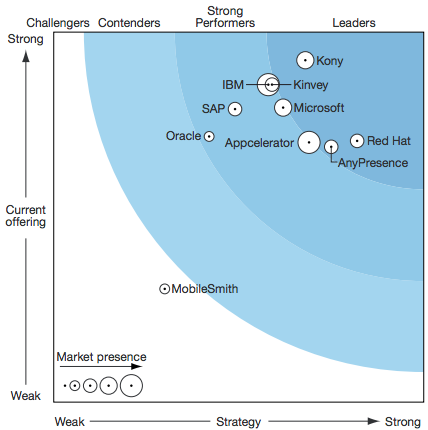
Fast on the heels of the Forrester Report on Mobile Infrastructure Services where Red Hat’s Mobile Platform was positioned as a leader,  this week Forrester released a new report for In Memory Data Grids and again Red Hat is positioned as a leader.

As they say in the report “There Is No Better Way To Achieve Blazing Fast Performance At Scale” – something I’ve been saying since we released the first version of JBoss Data Grid a couple of years ago. Another way to think about this is that there’s no better way to ruin a perfectly decent user experience that having slow, un-responsive applications. In memory data grids offer a quick solution to this without the cost and risk of major application re-architecture.

As with all Red Hat products, Red Hat JBoss Data Grid is pure Open Source and is based on the upstream Infinispan project.

More information on Red Hat JBoss Data Grid here.

Red Hat a leader in Mobile Infrastructure Services

When we made the decision to acquire FeedHenry last fall (almost a year to the day) – we wanted to be sure we were getting behind the future generation of mobile platforms and not trying to compete in the past. FeedHenry’s cloud-native mobile platform is focussed on developing and deploying the back-end (wiring data-sources and services) while keeping the front-end app. development open to customer choice. It’s also a first for Red Hat for a product line supporting node.js as the runtime for developing application logic. JavaScript on the front-end and the back-end is pretty powerful and a mobile platform that doesn’t support that would be pretty limiting today.

More validation of our choice comes in the form of Forrester’s recent report – “Mobile Infrastructure
Services, Q3 2015″ – diagram shown below.

Forrester’s research uncovered a market in which AnyPresence, Kony, and Red Hat lead the pack. Appcelerator, Kinvey, IBM, Microsoft, Oracle, and SAP offer competitive options. MobileSmith is a market Challenger.

The Forrester Wave™: Mobile Infrastructure Services Q3 2015

Now that FeedHenry is part of Red Hat and the integration with Red Hat’s broader cloud and middleware portfolio is progressing that Red Hat Mobile Application Platform’s market presence will improve considerably and Red Hat will advance further up and to the right .

Red Hat has moved into this market through acquisition of FeedHenry, and is quickly moving to connect its backend-as-a-service offerings to Red Hat’s own extensive set of integration tooling, JBoss Fuse.

Congratulations to the Red Hat Mobile team – this is a great way to celebrate the first anniversary !

DevOpsDays DC 2015

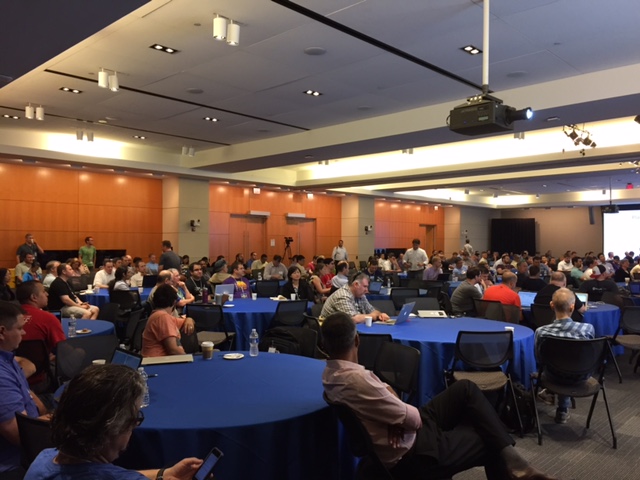
Making the most of the calm before the storm that is Red Hat Summit, I raced up to Alexandria, VA for a few days to attend DevOpsDays DC 2015, hosted at the pretty stunning USPTO offices. I heard from the organizers they reached capacity 400+ and sold out within a few days.

IMG_2469

Interesting mix of neck beards and suits. And there were some very senior suits – eg. Mark Schwarz (CIO of USCIS) – he had a keynote but sat through pretty much *every* talk over the two days – he clearly thought that was a good investment. and I’m sure he’s a very busy guy. Very unscientific poll – 2/3rds of the people I spoke with were Ops (not Dev background) and about 50% were public sector (vs private).

The Public Sector companies / individuals who spoke at the show (or who I spoke with) were all bought into agile and DevOps (self selected group I guess) – huge possible gains for organizations working with / for the Gov. – huge challenges as well. On taht note, I recently came across this Wired article that provides some good insight into how Public Sector IT is changing.

Red Hat was probably the biggest company sponsoring – others were Ansible, Chef, Elastic, Puppet, Sonatype and a bunch of smaller companies (mostly public sector tech consulting)

Aside from Shawn Wells (Red Hat) co-preso. on OpenSCAP, the best talk was Joshua Corman (CTO at Sonatype) “Continuous Acceleration with a Software Supply Chain Approach”

tl;dr – open source usage is booming, becoming a higher priority target for hackers so more high severity CVEs than ever. Projects are often slow to react and release fixes, vendors are even slower and customers are even slower. Basically we’re all doing a bad job. Treat the software supply chain like Toyota do – fewer, better managed suppliers, higher velocity delivery pipeline (ie. DevOps). Ergo – use Maven to at least understand your dependencies.

Second best talk – Ken Johnson and Chris Gates “Devoops and how I hacked you”. tl;dr – don’t download and run random stuff from the internet unless you expect to get seriously pwned. Ran through popular OSS tools and outlined the most common exploits – pretty eye opening. You could have heard a pin drop if it weren’t for the noise of people txting their colleagues to check wether  X, Y and Z were patched and updated. Basic stuff – default , unencrypted passwords. Old versions with known, well advertised but fixed exploits. Adopt devops so it doesn’t have to take 6 months to roll out a new (secure) version of Jenkins, WordPress, Drupal, etc.

Schedule : http://devopsdaysdc2015.busyconf.com/schedule

Recordings : DevOps Day 2015 on Livestream

Breakouts :

I joined a couple of the Open Space breakouts but was more interested in seeing what was popular. Here are the top four :

  1. Docker overview – 50ppl – poll – who’s using in prod – just 2 – it was actually only 1 – the other was a pre launch startup
  2. CI / CD – 100% about Jenkins. Most of the questions about scaling and performance or resilience.
  3. Secure automation
  4. Burnout and suicide prevention (sadly)

All in a all a good value show – will definitely make the time next year – though I suspect they’ll need a bigger venue.


Words to live by

Seen on a recent Reddit : Choose three hobbies :

  1. to pay the bills
  2. to keep you healthy
  3. to encourage your creativity

For me that would be software – though still looking for that pre-IPO opportunity so I can do more of 2 & 3; running / cycling (used to be soccer); and making / fixing stuff – more than happy to DIY vs. pay someone.

I’d add – it’s important to find the balance once you found your three things.

Photo is team Sharples – probably around 2001, Santa Cruz / Big Basin or thereabouts.

Net Neutrality

The FCC decision for Net Neutrality is a monumental decision but may not actually have much impact unless it continues to receive support – it’s obviously going to be challenged, and may be thrown out completely by whoever takes over the Whitehouse.

It’s unfortunate this has become a partisan issue – with the right seeing it as government control of the Internet and siding with the big carriers. IMO – anyone siding with the big carriers on this one has to be wrong.

UPDATE :

These editorials are worth reading :

“Net neutrality’s next chapter: How experts saw today’s milestone and next steps”, Gigaom

Micro services – the new architecture for digital engagement ?

Disclaimers and excuses.

I’d like to think I know as much or more than the average tech. pundit when it comes to building large-scale, resilient systems. In a previous life I spent the best part of a decade building large complex distributed systems for space, transport, telco. and utilities using CORBA, DCE, COM, WS*, REST, etc. So for what it’s worth here are my views on the latest architectural buzz-word du-jour – microservices. I’ve also heard numerous terms to describe the ideas behind microservices :

  • μservices (this one is bankrupt)
  • hipster-SOA (I like that one)
  • MSA (why does everything have to be a TLA in this industry ?)
  • agile SOA (this one has some merit)
  • SOA-2.0 (Just. No.).

I think I’m going to stick with microservices until someone proposes a better alternative.  But Agile SOA – yeh – I like that.

There are lots of articles on the web about microservices, and I’ve included links to what I believe are the better ones below. I’ve also seen quite a few conference presentations (some good, some bad) and they all fall into one of two categories :

  • In the trenches, doing it today, at scale for real customers.
  • Higher-level description and fundamental principles

There really aren’t many of the former and this post falls into the latter category. I haven’t been a “real” developer for at least 15 years  and I won’t show any detailed blueprints or code in this post. But I do intend to share some of my experiences, research and what I’m hearing from customers, analysts and other tech. pundits. I’ll also answer some questions I’m already being asked; a small sample here :

  • Isn’t a microservice architecture just SOA ?
  • Is this just the next software vendor buzz-word du-jour ?
  • How many LOC (Lines Of Code) is a microservice ?
  • Are there any applicable standards ?
  • Is an architecture build on APIs microservices ?
  • How do microservices relate to agile and DevOps ?
  • Where can I buy a microservice product ?

At this point I should add – these are my words and my opinion but they are heavily influenced by my role here at Red Hat where I run Product Management and where I have responsibility for a bunch of Red Hat’s Middleware products. I’d like to think I’m generally fairly impartial but I can’t promise not to be a little biased here and there. Finally – I’m learning here as well – I welcome challenges, questions, feedback and discussion. Comments are open.

New challenges.

So what has changed that has people across the industry questioning the architectural approaches and design decisions they’ve made in the past; or more importantly looking at alternatives to those architectures and practices for developing the next generation of applications ? A number of things :

Technical / architectural debt

When we talk about Applications in the Enterprises – we’re more often than not talking about complex compositions of intercommunicating systems – often developed over many decades using an array of technology. Individual elements of the “system” have their own release cadence, dependencies and often different owners with different goals. An increasing amount of energy is required to merely keep things running and avoiding outages that impact the business. Less and less energy is available to create competitive services and applications to serve the business.

The rise of DevOps

There is a strong headwind from the DevOps movement to radically change the way software is delivered and maintained. An essential element of DevOps is the notion of Continuous Delivery – a continuous stream of small, incremental chances to production applications instead of large disruptive upgrades. This requires an agile process and solid automated build and test using modern software development tools and practices.

Greenfield Opportunity – Digital Engagement

A shift towards developing net new systems that are focussed externally vs internally – if you follow Gartner – that’s the shift towards Systems of Engagement (or Innovation) or mode 2 applications using their Bi-modal IT vernacular. Or IDC’s third platform. Or Forrester’s “The Age of the Customer”.

Open Choice

During the last decade and a half – when building an application for the enterprise – there were two dominant choices – Java EE or .NET. More recently developer’s choices have expanded and IT has been willing to support a broader range of technologies. Especially for the kinds of green-field systems described above, developers are much more likely to make choices beyond the mainstream IT approved stacks and pick fit-for-purpose technology (eg. node.js for mobile, PHP for web, Java for middle-tier logic and back-end integration) Open source has made the technology that supports building resilient, distributed, web-scale applications far more accessible to far more developers. As with many other areas of technology – the innovation is happening in open collaborative communities and not in the ivory towers of traditional software vendors. Some notable examples are vert.xReactiveXNetflix OSS.

Anatomy of a Micro-service

    Microservices build on the same solid principles of good software design long espoused by practitioners of Object Oriented Systems and Service Oriented Architectures. Namely :
  • Loose coupling in all dimensions – time, lifecycle, type, location, interface, version.
  • Clearly defined purpose.
  • Autonomous – eg. taking responsibility for failure, resilience, security, etc.
  • Explicit Boundaries – self contained implementation; dependable public APIs.
  • Standards-based wire protocols, not language-specific APIs for interoperability (assuming heterogeneous technology)
  • Policy & Meta-data driven – favoring configuration changes over code changes

Microservices can only be useful in an underlying environment or with a platform that provides a means for :

  • service discovery
  • service replication (for availability and scaling)
  • dependency resolution and management
  • service failure detection and recovery
  • reliable and flexible build, package and deploy toolchain
  • service monitoring, alerting, eventing and introspection

Many of these technologies and solutions exist today and have been used successfully with monolithic and SOAs for many years but microservices deployments may push existing tools to the limit for a number of reasons – scale and heterogeneity. So this begs the question – “How is microservices different from SOA ?” Well, firstly – it’s not about size. We shouldn’t get too hung up on the “micro” prefix – services (micro or otherwise) should have a well-defined single purpose and a stable API – it shouldn’t matter if the implementation is 100 lines of COBOL or 900 lines of Scala. Some would argue it’s about the underlying technology – some pundits claim microservices is a movement against and away from traditional SOA and integration technology and vendors. I’m not convinced this is a major differentiator or driver for microservices – there are many ways to implement micro services and few people will be willing to completely burn their IT portfolio to the ground and start again. Well, I’m not completely convinced – I do think the whole integration space has become associated with large proprietary software vendor stacks and overly complex standards – I can understand why people are looking for a more agile, lightweight alternative. For me – the major change in thinking is something that we haven’t been talking about in the SOA world much in the last decade and that is operational agility and flexibility. Essentially, I believe microservices is good SOA principles married with modern DevOps practices – it’s an architecture that supports a fast cadence of continuous change in an operational environment vs big-bang upgrades with long release cycles. That’s an architectural approach married with an agile process for delivering the new breed of customer engagement applications I discussed previously.

Some Cautionary Notes

Building reliable, maintainable distributed systems is hard and many of our previous assumptions about software development no longer apply. As we learnt with CORBA and COM – moving objects / services out of process adds latency, performance and code overhead. It introduces failure scenarios and potential security exploits that didn’t previously exist – eg. well constructed in-memory function calls rarely if ever fail; add an air gap and everything changes – the code overhead to handle failures, retries, security, etc. likely eclipses the application complexity (and cost) itself. This was also true moving from non-SOA to SOAs. Managing service dependencies is also a challenge – we faced similar challenges building distributed systems with DCE, DCOM and CORBA and more recently SOAs and that underlined the importance of governance and API management tools, but microservices architectures will exacerbate the issue as we increase the number of services. Decomposing applications into fine-grained services each with their own process-space and possibly their own container / virtual-machine introduces additional resource utilization and process management overhead. Finally and as I mentioned above – micro services architectures build on solid SOA principles to solve some very real operational bottlenecks – I strongly suspect that successful microservices practitioners are also successful agile and DevOps practitioners.

Summary

Microservices is an architectural style that builds on solid principles of good software design – when used in a mature DevOps environment it can increase the cadence of change without increasing the risk and cost of maintaining large, complex systems. It delivers operational flexibility and agility but it comes at a cost. It requires developers to understand distributed systems development and requires sophisticated systems and application management tools. Ultimately people will have to make the tradeoff between operational agility and development complexity Microservices represents an evolution not a revolution and IT practitioners should avoid micro service envy and rush to re-architect perfectly serviceable applications without discrete problems in mind than can be solved with a move to microservices. Oh, and if someone tries to sell you a microservice product – run away as fast and far as you can.

Further Reading 

“What is so Special about Microservices? An Interview with Mark Little” , InfoQ, February 2015 “Micro services : Decomposing Applications for Deployability and Scalability”, Chris Richardson, InfoQ, May 2014 “Micro services” by Martin Fowler, ThoughWorks, March 2014 “Micro-Services – Java, the UNIX way” by James Lewis, ThoughWorks, Sept. 2013