If you know anything about me, you know the two things that test my resistance are bike shops and the Apple stores. So, over the weekend, I found myself in the local Apple store and chatted with the guy serving me. The discussion led to the Vision Pro. With a bit of time on my hands, I agreed to a quick 15-minute demo.
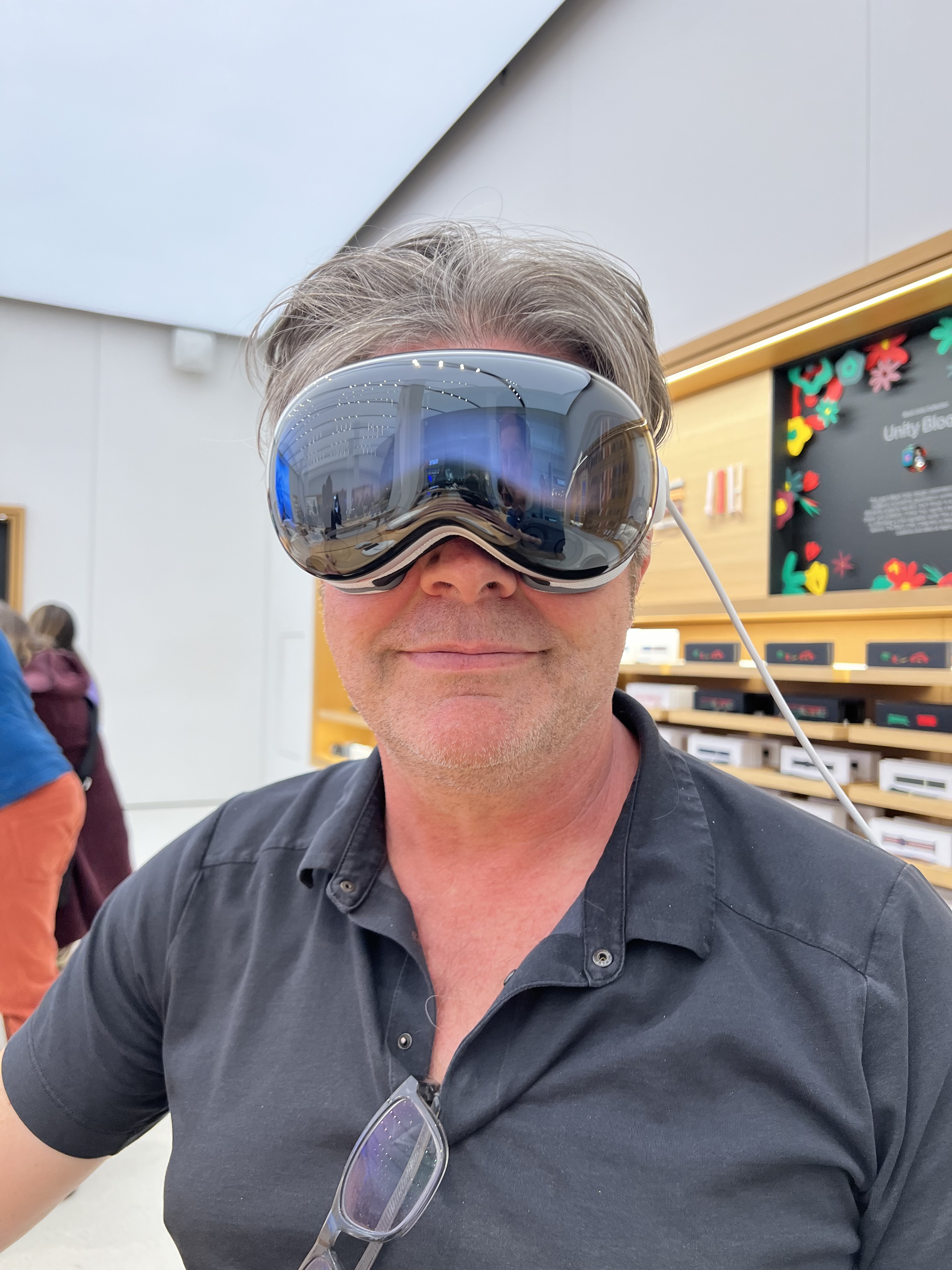
I wear progressive lenses with a pretty complex prescription, so the first potential hurdle was getting the optical inserts set up and whether they would even support my prescription. Apple has an in-store machine that will measure your existing eyewear, so you don’t need to have your prescription details. That worked incredibly quickly, and the store will even mail you the settings for later use.
The headset is quite a bit smaller and lighter than I expected – I have owned the last few iterations of the Meta headset, and they’re much bigger. The device feels well-engineered, and the materials feel the quality you’d expect on a $3500 device.
I only had a quick 15-minute scripted demo, so I didn’t have much time for free play, but here are the things that really jumped out at me.
Ergonomics – It may help that I’m a long-time Apple user, but the user interface felt incredibly natural – after just the briefest of explanations, I could open, close, move, resize windows, zoom, and scroll. This in itself is incredible for a couple of reasons:
- There are no hand controllers – you just use your eyes to select things on the screen and your fingers to perform operations
- The accuracy is pretty impressive, considering what is going on here.
With one exception – you have to use the watch-like bezel on the headset for specific operations – there has to be a good reason for this departure from the hand gesture UI – I just can’t think what it is.
Video and audio quality – the regular UI is really nice – if you’re used to having one or more big curved monitors on your desk – you will be at home. Where things get really amazing is the 3-D immersive video. The demo movies were on par with a recent trip to the Sphere in Las Vegas – parts of your brain really are tricked into thinking that you are there, inside the movie. There were a couple of demos of sports games. I think this could be an opportunity for Apple – for the real sports aficionado – the sticker price probably won’t be a significant obstacle – I just don’t know how many broadcasts take advantage of the technology today – if the EPL gets on board. I will have to take a second look! Watching regular TV and movies – I’m less certain about that – those things are relatively social activities and I can’t imagine households buying multiple headsets.
For me, the question remains—would I buy it, and more importantly, would I use it? The short answers are —no, I didn’t buy one, and no, I don’t think I would use it. I can say this with some certainty as I bought the last couple of iterations of the Meta headsets and stopped using them after about a month.
The longer answer is less certain. I’d love a more extended session with a keyboard and mouse pad and determine if it could be used for work. My current office setup is nice, and the cost easily exceeds the price of a Vision Pro. The problem with the work use cases is that Apple really caters to creative workers – designers and developers – both need decent power on their desktops. The Pro is M2 powered but specced like a mid-range laptop – if you are doing builds, video encoding, etc., that probably isn’t going to be enough given the horsepower needed to deliver the Pro UX. So you’re likely going to have your regular laptop/desktop and use the Vision as the display – that is currently supported, but I didn’t play with that feature – I think that could be pretty neat. I have a few Apple (and other) machines in my office and use virtual displays regularly.
I think AR/VR’s time will come as the technology evolves and the use cases and killer applications become more apparent. What we see with the first version of Vision Pro and Meta’s latest offering are incremental steps in a revolution in human/computer interaction. I’m looking forward to a longer demo and to see what version 2.0 looks like.


 Rich Sharples' Weblog