After another good breakfast at Cafe Feellove in St George, we headed over to the Red Lion Hotel to meet our fellow riders, and our RimTours guides – Beth, Birdie, and Lauren. After meeting the crew we loaded our gear onto the trailer and headed to our start point 2 hours away on the Kaibab Plateau.
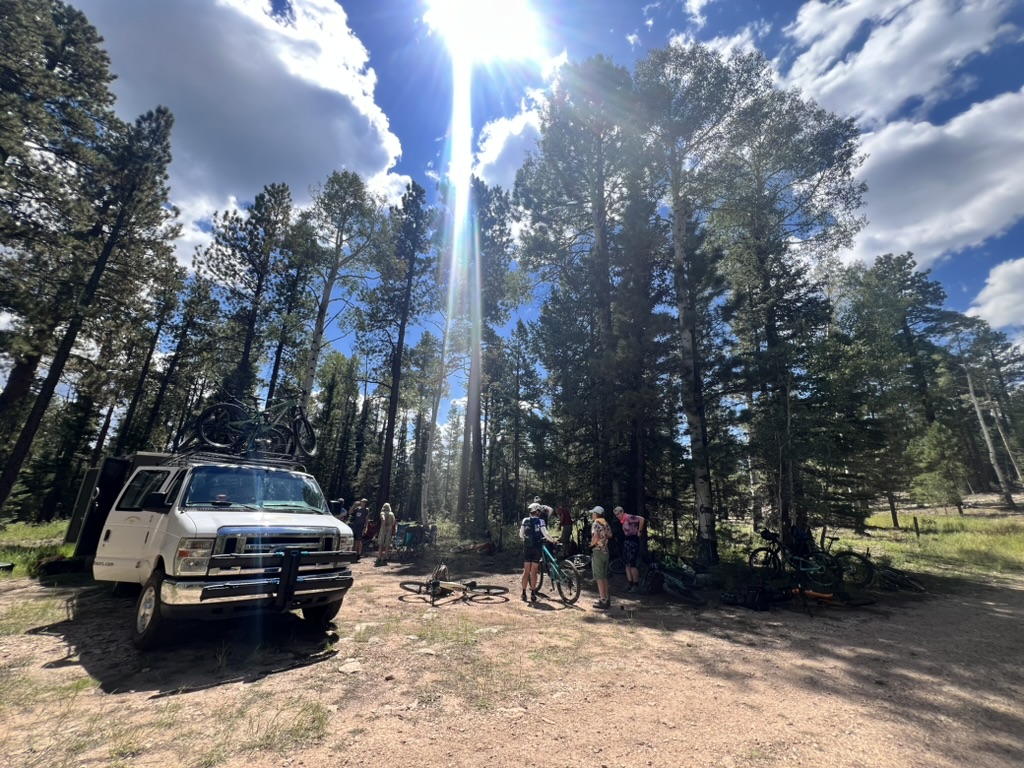
We stopped briefly at the Jacob Lake Visitor Center to pick up three more riders and drop our rental car. then another short drive to pick up the Arizona trail once we got our bikes setup.
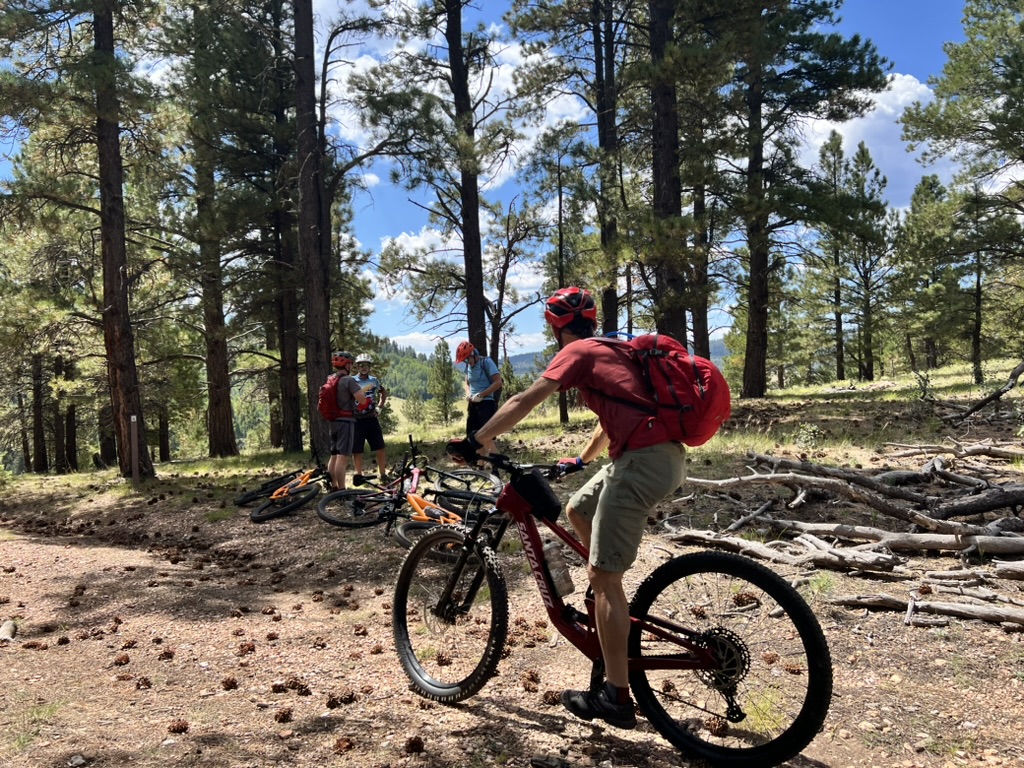
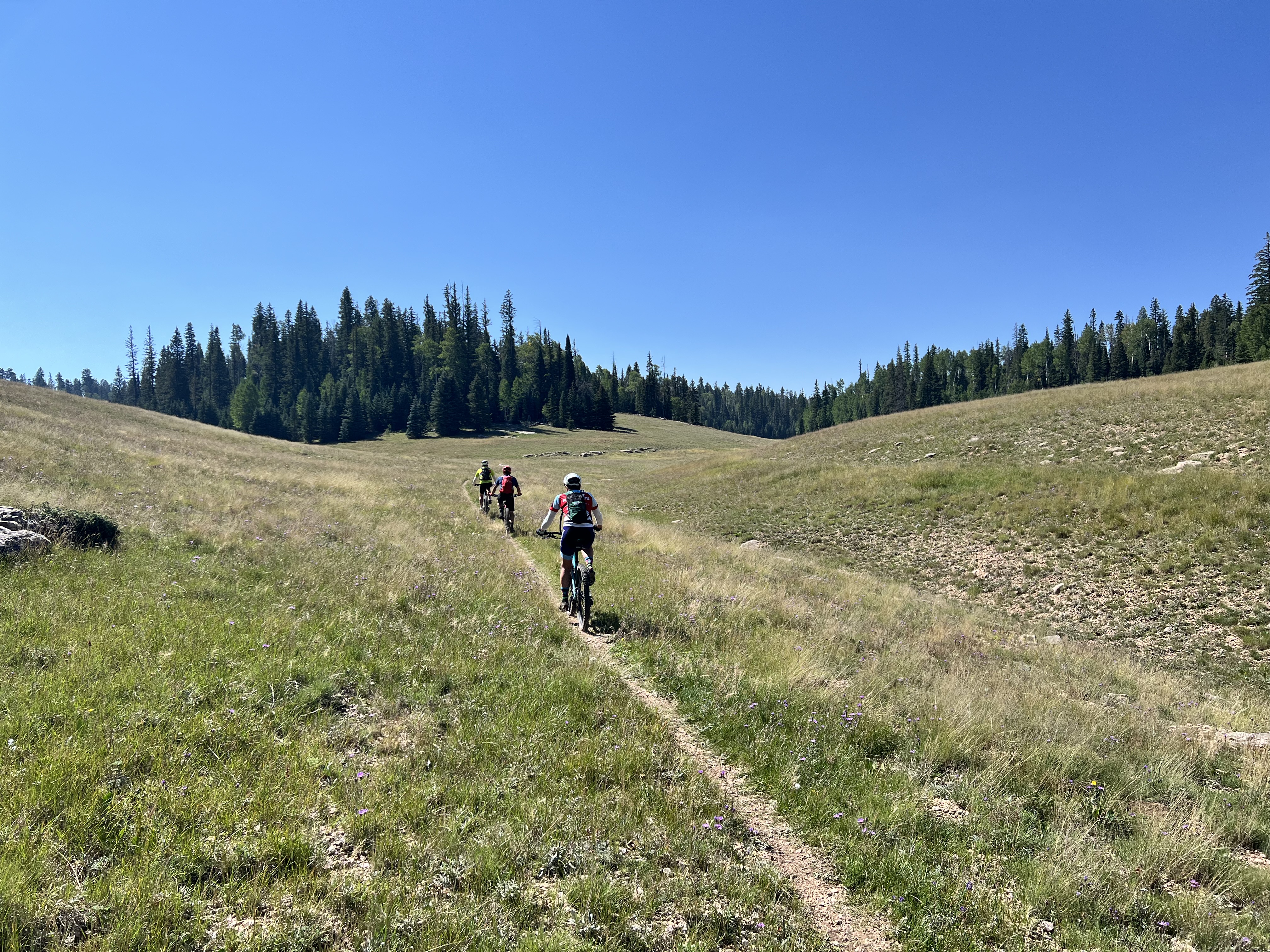
The first day was pretty light (just 14 miles) but had a couple of short technical climbs. All the riding was between 8500ft and 8800ft and this was my first exposure to strenuous exercise at a decent elevation. Our guides warned us to take it easy on the first climb – I really had no choice – it felt like I was breathing through a mask ! After a quick lunch stop and more bike adjustments, on to our campsite for the night at the East Rim Overlook. Note – campsites here are basic – usually just a sign telling you where you can and can’t camp. No pit toilets, no water, no shelter, no network. You have to bring everything you need with you – or in our case pay RimTours to do it !
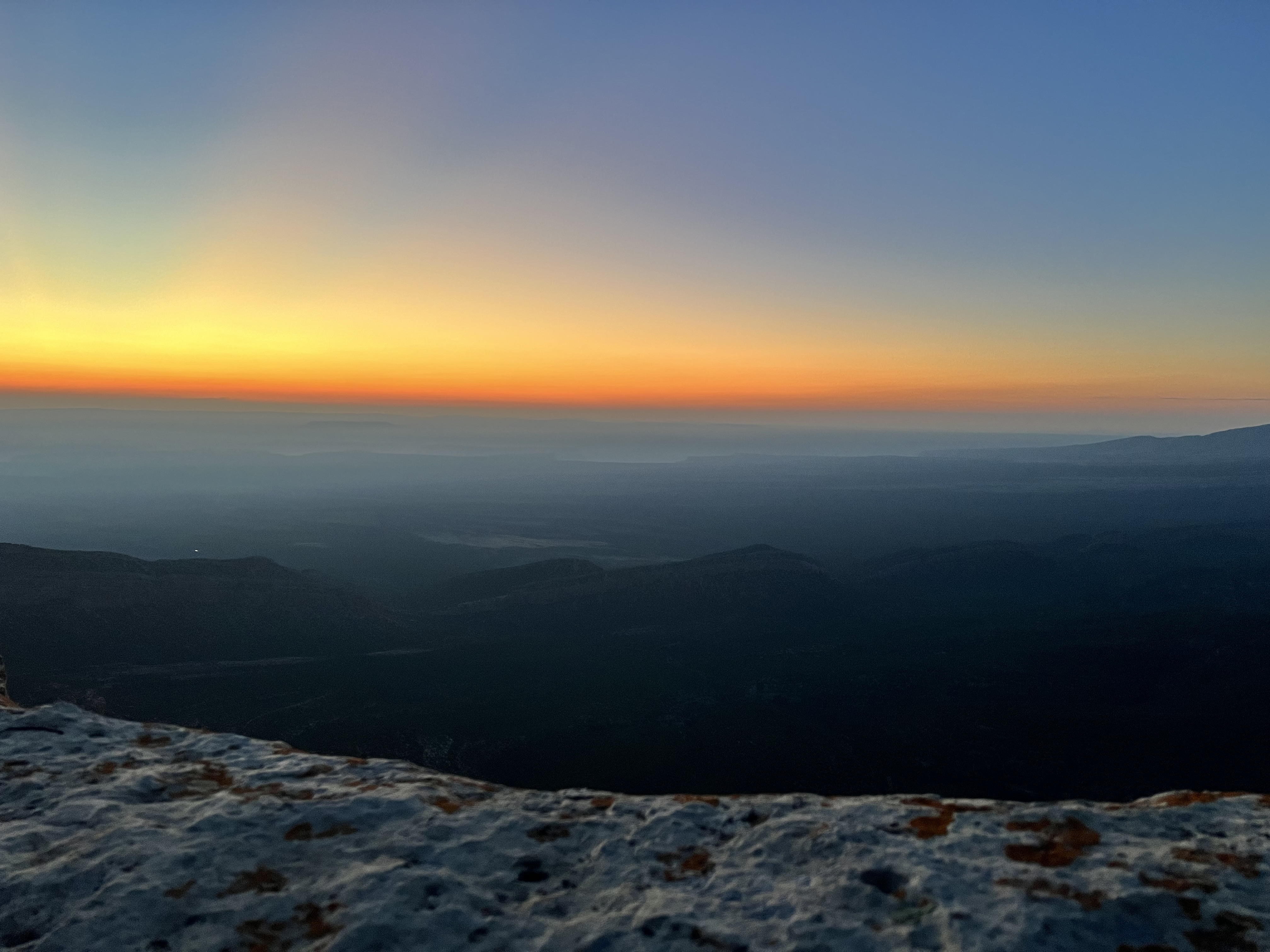
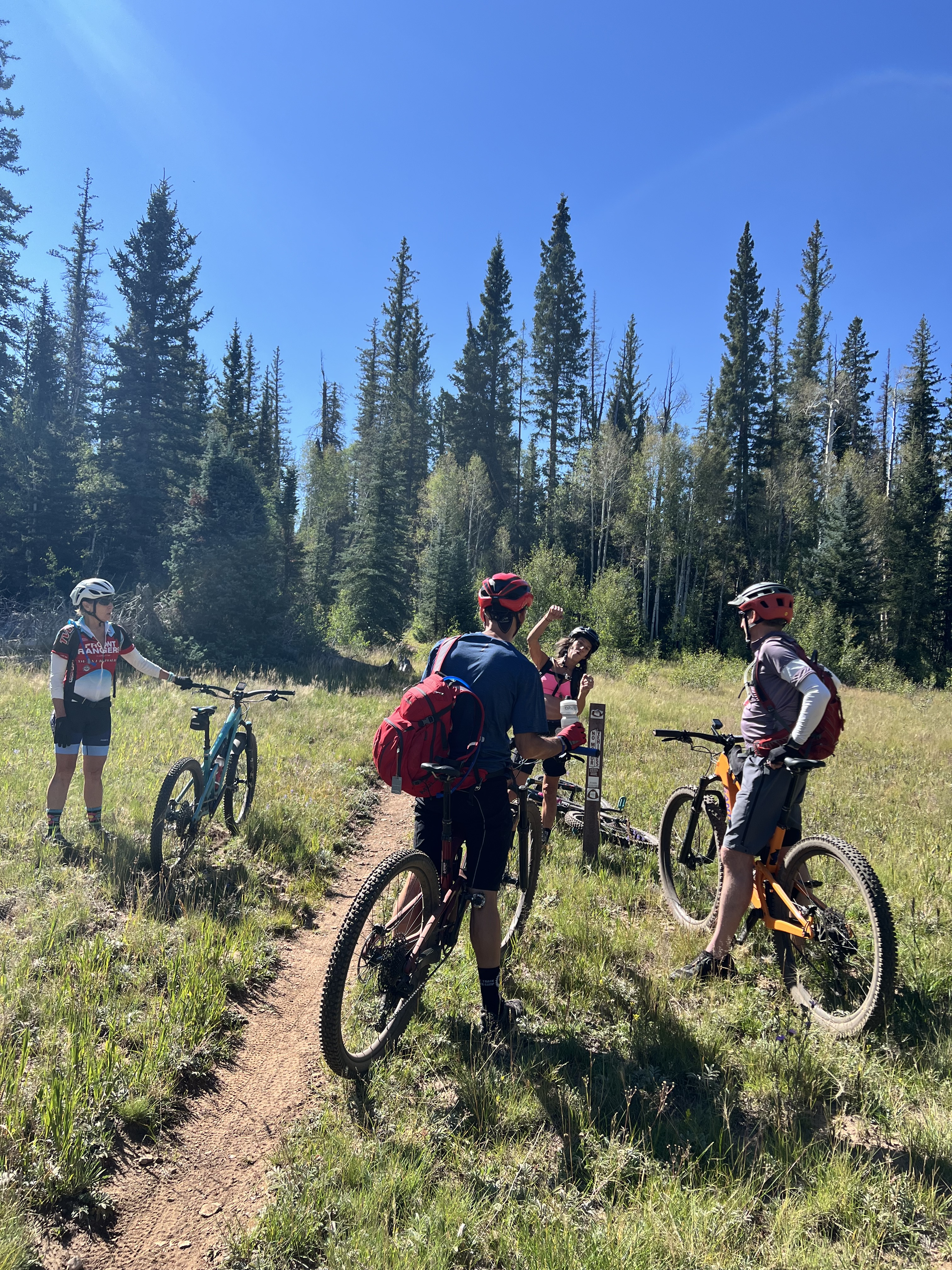
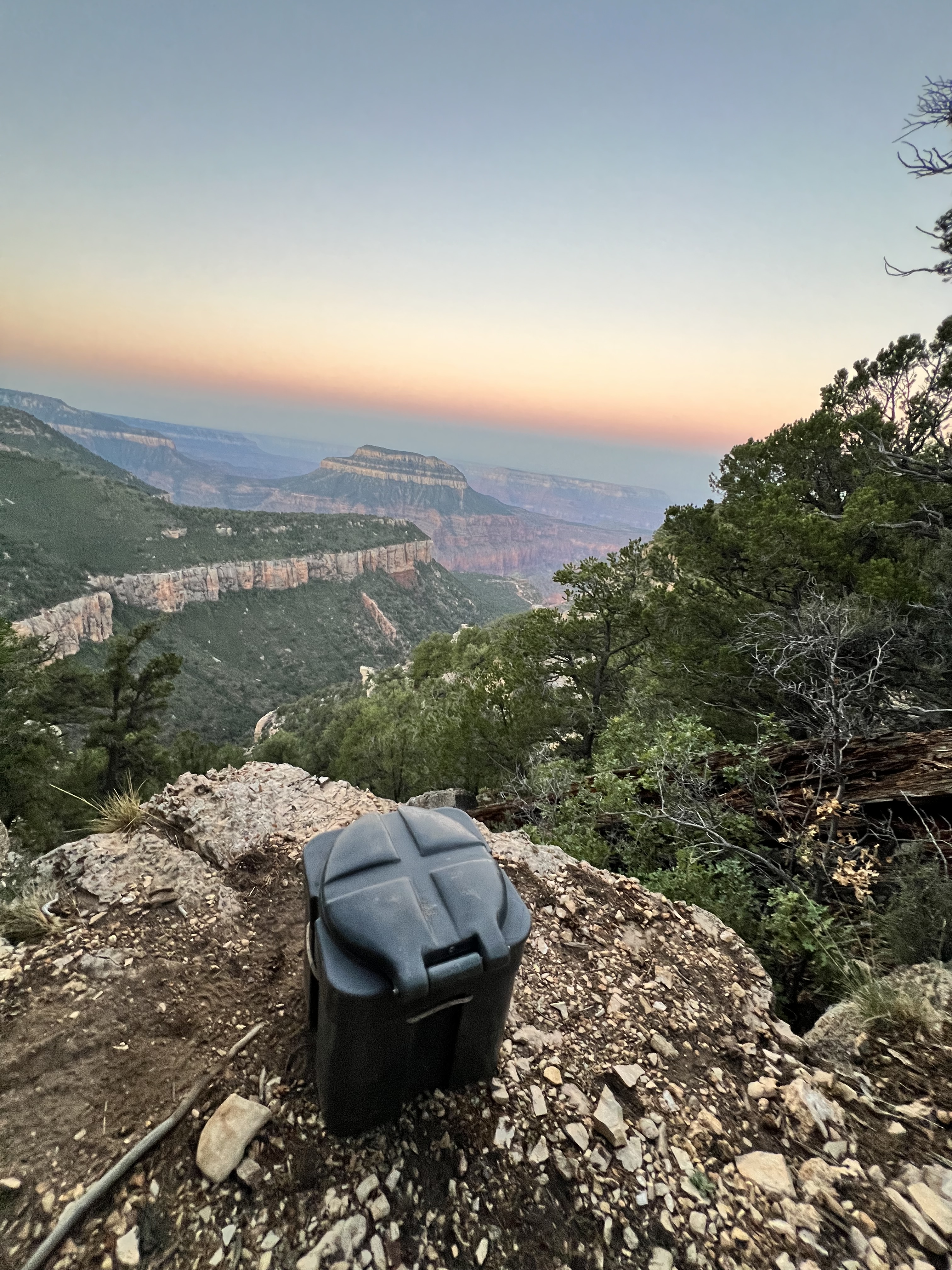
Still on East Coast time, I was up early enough for the sunrise yoga / stretching overlooking the Colorado river. The 4th picture below is the site of our “Groover” which seems to find the most scenic viewing spots one these trips. After breakfast and decamping – we jumped back on the Arizona Trail. We had a much longer ride (32 miles) – some single track, some high-prairie, and some forest service roads. We peaked around 9000ft but ended the day at Locust Point campsite around 7600ft. Fortunately for my lungs – not much climbing but it was a long day of riding and once we had setup camp and eaten another awesome dinner prepared by our guides – it was time to grab a beer and watch the sunsetting.
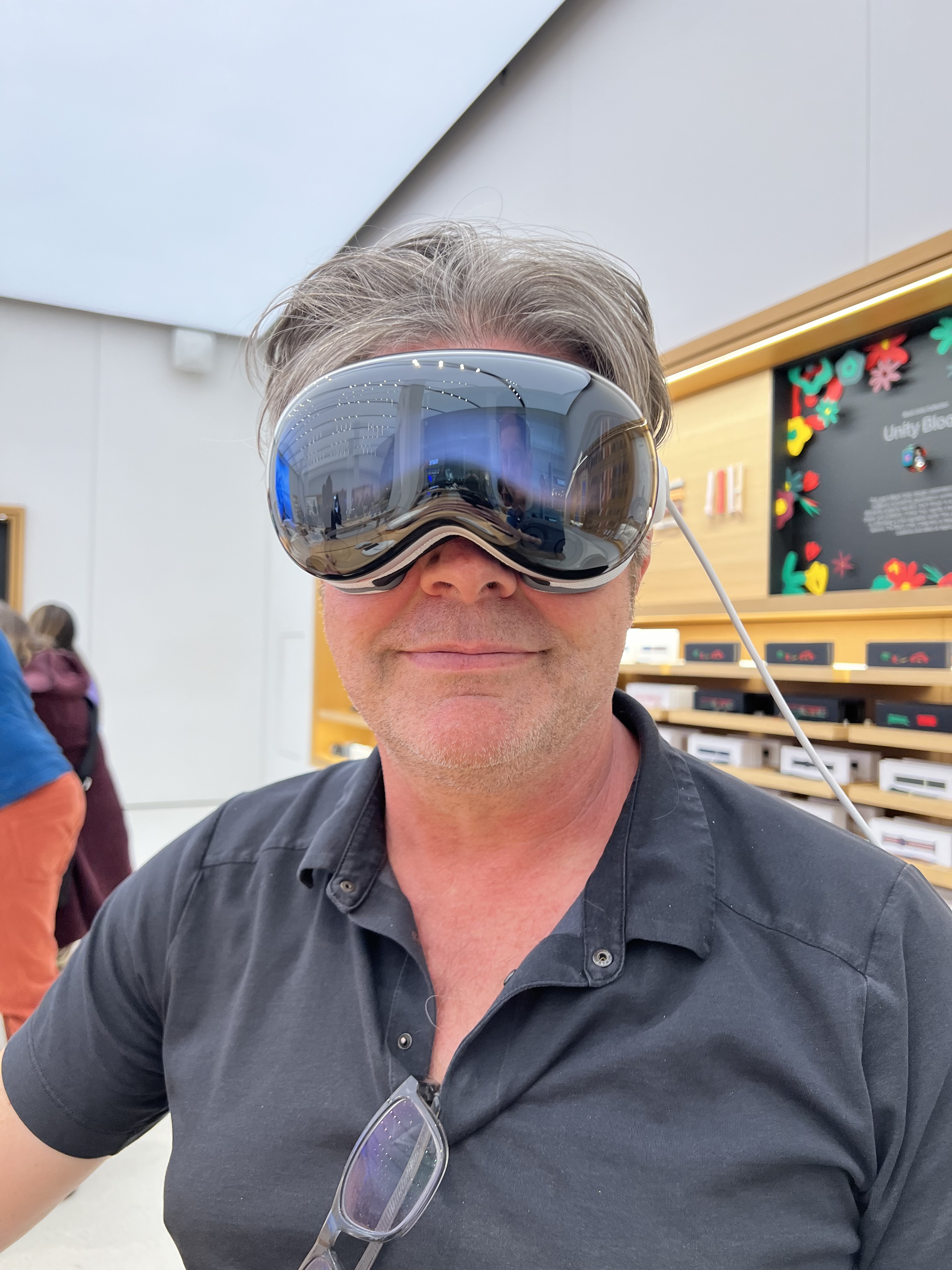
If you know anything about me, you know the two things that test my resistance are bike shops and the Apple stores. So, over the weekend, I found myself in the local Apple store and chatted with the guy serving me. The discussion led to the Vision Pro. With a bit of time on my hands, I agreed to a quick 15-minute demo.
I wear progressive lenses with a pretty complex prescription, so the first potential hurdle was getting the optical inserts set up and whether they would even support my prescription. Apple has an in-store machine that will measure your existing eyewear, so you don’t need to have your prescription details. That worked incredibly quickly, and the store will even mail you the settings for later use.
The headset is quite a bit smaller and lighter than I expected – I have owned the last few iterations of the Meta headset, and they’re much bigger. The device feels well-engineered, and the materials feel the quality you’d expect on a $3500 device.
I only had a quick 15-minute scripted demo, so I didn’t have much time for free play, but here are the things that really jumped out at me.
Ergonomics – It may help that I’m a long-time Apple user, but the user interface felt incredibly natural – after just the briefest of explanations, I could open, close, move, resize windows, zoom, and scroll. This in itself is incredible for a couple of reasons:
There are no hand controllers – you just use your eyes to select things on the screen and your fingers to perform operations
The accuracy is pretty impressive, considering what is going on here.
With one exception – you have to use the watch-like bezel on the headset for specific operations – there has to be a good reason for this departure from the hand gesture UI – I just can’t think what it is.
Video and audio quality – the regular UI is really nice – if you’re used to having one or more big curved monitors on your desk – you will be at home. Where things get really amazing is the 3-D immersive video. The demo movies were on par with a recent trip to the Sphere in Las Vegas – parts of your brain really are tricked into thinking that you are there, inside the movie. There were a couple of demos of sports games. I think this could be an opportunity for Apple – for the real sports aficionado – the sticker price probably won’t be a significant obstacle – I just don’t know how many broadcasts take advantage of the technology today – if the EPL gets on board. I will have to take a second look! Watching regular TV and movies – I’m less certain about that – those things are relatively social activities and I can’t imagine households buying multiple headsets.
For me, the question remains—would I buy it, and more importantly, would I use it? The short answers are —no, I didn’t buy one, and no, I don’t think I would use it. I can say this with some certainty as I bought the last couple of iterations of the Meta headsets and stopped using them after about a month.
The longer answer is less certain. I’d love a more extended session with a keyboard and mouse pad and determine if it could be used for work. My current office setup is nice, and the cost easily exceeds the price of a Vision Pro. The problem with the work use cases is that Apple really caters to creative workers – designers and developers – both need decent power on their desktops. The Pro is M2 powered but specced like a mid-range laptop – if you are doing builds, video encoding, etc., that probably isn’t going to be enough given the horsepower needed to deliver the Pro UX. So you’re likely going to have your regular laptop/desktop and use the Vision as the display – that is currently supported, but I didn’t play with that feature – I think that could be pretty neat. I have a few Apple (and other) machines in my office and use virtual displays regularly.
I think AR/VR’s time will come as the technology evolves and the use cases and killer applications become more apparent. What we see with the first version of Vision Pro and Meta’s latest offering are incremental steps in a revolution in human/computer interaction. I’m looking forward to a longer demo and to see what version 2.0 looks like.
I covered Roadmaps in a previous post, but product roadmaps cannot be created in isolation. Roadmaps must support your company or organization’s strategic direction captured in its Mission and Vision. I’ll outline these essential concepts and explain how they are connected to form a strategic planning framework.
First, clarifying the terms Vision and Mission is necessary. I’m using the term Mission to mean “the organization or product’s reason for being.” Mission is often used synonymously with Purpose, which I will use interchangeably. Occasionally, Mission is sometimes used as a synonym for Vision, but I find this confusing and will avoid doing this.
I use the term Vision to mean the organization or product’s future state – i.e., where the strategy will take the organization or product.
Mission
Your organization’s Why” is its core purpose and reason for its existence. It defines the fundamental value your brand contributes to your customers and users, the market, or the world and the positive impact it strives for. Think of it as the North Star that guides your decisions.
Your Mission should be captured and shared as a clear Mission Statement. Your Mission statement must be ambitious but also practical and achievable. It should also be durable and relatively static – it’s not uncommon for successful companies to have the same Mission for the organization’s lifetime.
It’s not uncommon for organizations to have an undeveloped or unclear Why – If you’re interested in developing or improving your organization’s Why, you could do much worse than start with Simon Synek’s Why, How, and What.
Vision
Your Vision is your organization’s “where” or aspirational future state. It paints a vivid picture of the market landscape when everything goes according to plan, considering future trends, threats from your competition, and opportunities. It serves as the guiding light for long-term investments and innovation efforts. Vision is about the future. Vision is aspirational and typically has a 3-5 year horizon.
Strategy
Your strategy is the actionable plan to achieve the vision. It translates the broad aspirations of the vision into concrete steps, considering resource constraints, market realities, and technical feasibility. It should be adaptable and responsive to changing market conditions and emerging technologies. In a larger organization, you will likely have a refinement of the corporate vision specific to the business or product, but the connection should be clear.
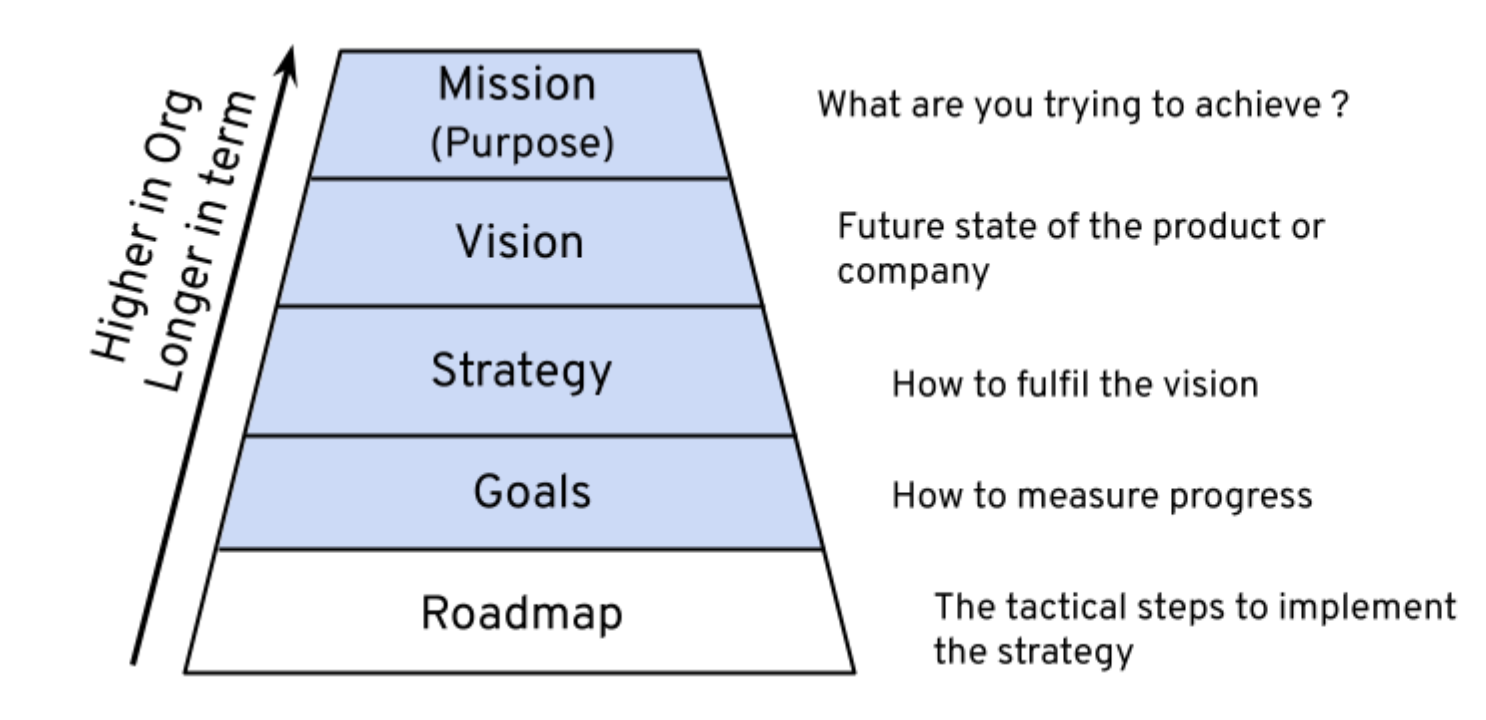
I present the hierarchy like this to represent the organizational altitude because it’s much more natural in larger organizations with multiple business units or products. It also helps you to think of the duration of these terms. At the top of the pyramid is Mission or Purpose – this could and should not change significantly over several years, decades, or even the organization’s lifetime. Vision is more likely to have a 3-5 year horizon. Strategy and Goals are linked to annual planning, and the Roadmap gets down to specific months, quarters, and year halves.
Likewise, Mission, Vision, and Strategy are typically defined at the company level and cascade down to business units or products, which will refine Strategy and Objectives to focus on the elements they can deliver or support.
Goals
I’m a big fan of OKRs (Objectives and Key Results) as a way to define and manage the execution of strategic goals, and I have successfully used OKRs in large and small organizations. Well-written OKRs help your team or organization achieve focus, accountability, engagement, transparency, and visibility. If you’re unfamiliar with the ORK framework – there’s no better place to start than John Doerr’s 2018 Ted Talk. There are many other goal management frameworks, and the advice below is general enough for any method. The important thing is that strategy alone is not enough – execution of the strategy needs to be monitored and managed.
Objectives capture your strategic initiatives – i.e., what your business unit, team, or product must do to support the business strategy or higher-level Objectives. They need to be inspirational enough to motivate people but also attainable to some degree – i.e. successful attainment should be between 80 and 120%. Well-written objectives clarify what the organization should be working on. Objectives shouldn’t be used to track an organization’s ordinary/mundane operations – you should have other ways to track those things. OKRs are better for monitoring ambitious goals- i.e. to help you achieve extraordinary results.
“Without strategy, execution is aimless. Without execution, strategy is useless.”
― Morris Chang
Each objective must have one or more Key Results – how you measure progress and ensure you stay on track to meet your objectives. Each objective should have between 2 and 5 Key Results at a given organizational level.
OKRs should be part of your annual planning, with quarterly reviews and the potential to make changes at least biannually.
In larger organizations, OKRs cascade down the organization. Depending on the nature of your OKRs, you could define supporting objectives at each level in the organization or have objectives that apply to all levels and Key Results defined at different levels so the results contribute to the level above.
The Whole Picture
There is plenty of literature on crafting Vision Missions and strategy. I’m not going to go into any more detail in this post – but as a Product Manager – it’s essential to understand how the concepts are connected. More importantly – Visions, Strategy, Goals, and Roadmap must be clearly and unambiguously connected.
Summary
To summarize, the mission is about the present, the vision is about the future, the strategy is the plan to achieve the vision, and the goals are the objectives that capture your strategic initiatives. OKRs are a great way to define and manage the execution of these strategic goals.
A well-defined Mission, Vision, and Strategy with clearly aligned Objectives will ensure your organization has focus, clarity, and the inspiration to succeed.
We don’t need stinkin’ roadmaps! Yes, you do, except in some rare circumstances, which I’ll outline below.
For clarity – let’s define the term:
A product roadmap is a visual summary that maps out your offering’s features and capabilities over time and helps your customers and stakeholders understand your direction and progress toward fulfilling the product’s goals.
There are many reasons you need a product roadmap.
If for no other reason, you need a roadmap for your medium-term (e.g., quarterly) planning. In this case, your roadmap is nothing more than a wish list of features with some form of prioritization. If you don’t have this – you can’t plan.
Your engineers and other downstream collaborators need to be able to see further than the next 2 or 3 sprints. Knowing what’s over the short-term planning horizon will help them make more informed design decisions, optimize hiring and training, and support better resource allocation.
If you are a B2B product company – your salesforce needs a roadmap to understand how the product will close a competitive gap or when you will deliver a capability required by a particular customer segment. Your roadmap helps sales plan their engagements more efficiently and effectively.
Enterprise (B2B) customers need a roadmap – it helps them determine whether you are progressing toward your stated product vision, and it helps them plan upgrades, expansions, or migrations. More practically, it allows them to understand where you are vs the competition in addressing their needs.
Most B2B sales combine what you have in the product today and what your roadmap and vision tell the customer about where you are heading.
If you are in a larger company – your leadership needs to know that you are investing the company’s finite resources in the way that gives the best return and helps attain the company’s objectives.
If you are a startup, your investors/board will take an even keener interest in your investments – in many cases – it’s their money. Expect to defend your investments and the roadmap.
If your management or investors aren’t interested in your roadmap, you may have more significant problems. I’ve experienced this when revenue and growth are the only indicators of product success. Unfortunately, revenue and growth are trailing indicators – they only expose mistakes already made in the last quarter or year. Product roadmaps (and justification and prioritization behind them) can give organizations better insights before resources are committed and potentially wasted on the wrong things.
There are situations where you don’t need to share a roadmap beyond the immediate product team, and the roadmap is primarily a planning tool and a way to demonstrate progress to your management or investors.
If you’re releasing a barebones MVP to assess Product Market Fit – you don’t need a roadmap.
If you are a B2C product company – your customers don’t need to see a roadmap – have you ever seen a roadmap for your favorite smartphone or video game?
If you have a very stable product in a very stable market – your customers probably value stability over change – a roadmap is not going to be a priority and will be limited to ‘features’ that show customers that they can depend on your product to keep working the way it does (e.g., support for newer hardware or operating systems)
In short, if you’re a product company, your product roadmap is your product strategy manifest, how you plan to make the proper steps towards your goals. Everything on your roadmap should align with your goals in support of your vision and objectives.
If you think visually, this diagram may help tie vision, strategy, and roadmap together.
Who owns the Roadmap?
Product Management is ultimately responsible for maintaining the roadmap, but creating the roadmap is a collaborative effort. Your stakeholders in sales and marketing need to be aligned with your roadmap and understand the next level of detail behind the roadmap. Your stakeholders need to be sure that the roadmap is aligned with and fulfilling your vision and strategy – there needs to be a direct line between the roadmap and the strategy – if your stakeholders understand the strategy, then there should be no surprises on the roadmap because they will be fully aligned.
Tools
I generally prefer to present roadmaps from the tool I use to create roadmaps – ProductBoard is my current favorite, but tools like Monday, Ignition, Jira Product Discovery, etc., all allow you to manage and prioritize features, align with goals and strategic objectives and pull together an interactive and professional roadmap. There are a few occasions when you may need to pull a roadmap presentation into a slide deck (board meeting, strategic customers), but your PM planning tool should be your only source of truth for the roadmap. I find using a specific roadmap/planning tool gives you more credibility – everyone knows you can throw together a roadmap slide five minutes before the meeting – using the tool that drives your planning is a different level of commitment.
Scope, detail, and uncertainty
For a fast-moving product company in a fast-moving market – a 2-3 quarter roadmap is sufficient, and anything beyond that is highly speculative. I prefer to be very explicit about that – there’s a bucket of features over the planning horizon – these things are still worth sharing – your audience (internal or external) can help you prioritize those features. Different markets and products will have different dynamics – a roadmap for a mature product in a mature market will have a much more static roadmap, and planning could extend into 6-8 quarters for major features or releases. These are generalizations, obviously – even mature products will occasionally have to be agile and quickly plan and release new features at the expense of roadmap stability. Likewise – if you are in a fast-moving segment, you will still have strategic roadmap items – like significant architectural changes or re-platforming, where the work takes longer. Hence, you need a longer planning horizon and roadmap.
There will always be some uncertainty on a roadmap. The further out something is on the roadmap – the lower the certainty and detail. Beyond one year – my unplanned bucket is nothing more than curated feature ideas with little detail or commitment behind them. Conversely, in the near roadmap – this quarter, next quarter – many of these features should be committed, i.e., Planned – you likely have a level of detail that allows you to engage with design and engineering and may already have an execution plan (e.g. Start sprint and sizing/cost). You will have a lot more detail and may already share details such as wireframes and conceptual designs with customers and internal SMEs. My rule is that your next quarter’s roadmap should be 80-90% accurate, two to three quarters out – 50-60% accuracy, and beyond that 20-30% – ie. Largely speculation.
Finally – roadmaps are an honest attempt to share how you are executing against your stated strategy or vision. Still, the only thing certain about a roadmap is that nothing is certain about a roadmap. I always lead with the caveat that things can and will change, and many larger organizations I’ve worked with have legally-approved disclaimers on roadmaps to make it clear that they are not legally-binding commitments. Occasionally, there will be exceptions – some items on your roadmap are high-integrity obligations to customers, partners, and other internal dependent teams, but everything else can and will change depending on numerous internal and external factors – market dynamics, higher priorities, etc.
Themes and Objectives
In an ideal world – your product roadmap is your strategy manifest. It shows how you are delivering against your strategy and vision or short to medium-term progress towards your long-term goals. For any reasonably complex product or portfolio of products, your strategy will break down into themes or objectives, and your roadmap will align with those objectives.
Roadmap Mistakes
Don’t be unrealistically specific about dates. The most accurate roadmap is the one with no dates at all – just “now,” “next,” and “later”. If you can’t get away with that (e.g., B2B), calendar quarters or halves for further out. Plans constantly change, and estimates are optimistic, so don’t delude yourself.
If your roadmap doesn’t reflect or support your strategy or vision, then people will be inclined to think that your strategy isn’t real or you’re failing to deliver on your vision.
If you have multiple versions of your roadmap in slide decks and documents dotted around your company intranet, they will all be out of date at some point. This will lead to confusion and busy work. You must have a single source of truth to which everyone has (at least read-only) access.
List of disconnected features. Your roadmap is your strategy manifest, so if it’s just a scattershot of features with no apparent structure, what does that say about your strategy? Thematic roadmaps are critical for portfolio companies – the themes help your colleagues in marketing get behind a small set of impactful messages.
Conclusion
Except in some rare cases – your product needs a roadmap. Your roadmap is a tactical enforcement of your vision and strategy, and there must be obvious alignment. Organizing your roadmap under broader objectives or themes will help enforce the alignment. Product roadmaps are dynamic documents and should be reviewed constantly, and the dynamic nature of your roadmap should be clearly communicated. Given the dynamic nature – ensure there is a generally accessible single source of truth for your roadmap.
Day 0 (May 18th, 2023) was our acclimation day before heading off into the Canyon Lands on our 5-day MTB tour of the Maze organized through Rimtours. We started with Breakfast at the Jailhouse – a bit of a Moab institution. Then some last-minute shopping for gear and food/drink. In the afternoon – we crammed a lot more into our last day of civilization for a while – Arches NP Hike, more shopping, dinner, and Slickrock Sunset.
(from left to right – David, Rich (author), Bryan, Tim, and Iain)
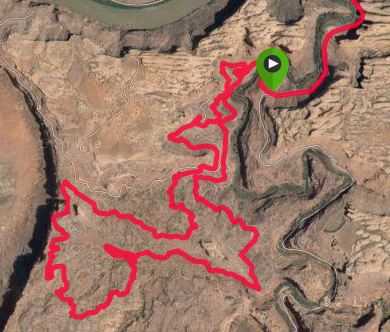
Please be advised that if you intend to hike at Arches National Park, a highly popular destination, it is important to book in advance. Otherwise, you may face disappointment and be turned away at the gate. As most of us have already explored the more popular sights at Arches, we ventured deeper into the park towards Devil’s Garden. We followed the regular trail to Double O Arch and Fallen Angel and returned via the more interesting primitive trail. Hiking at Arches never disappoints though it can get pretty crowded. Strava map here.
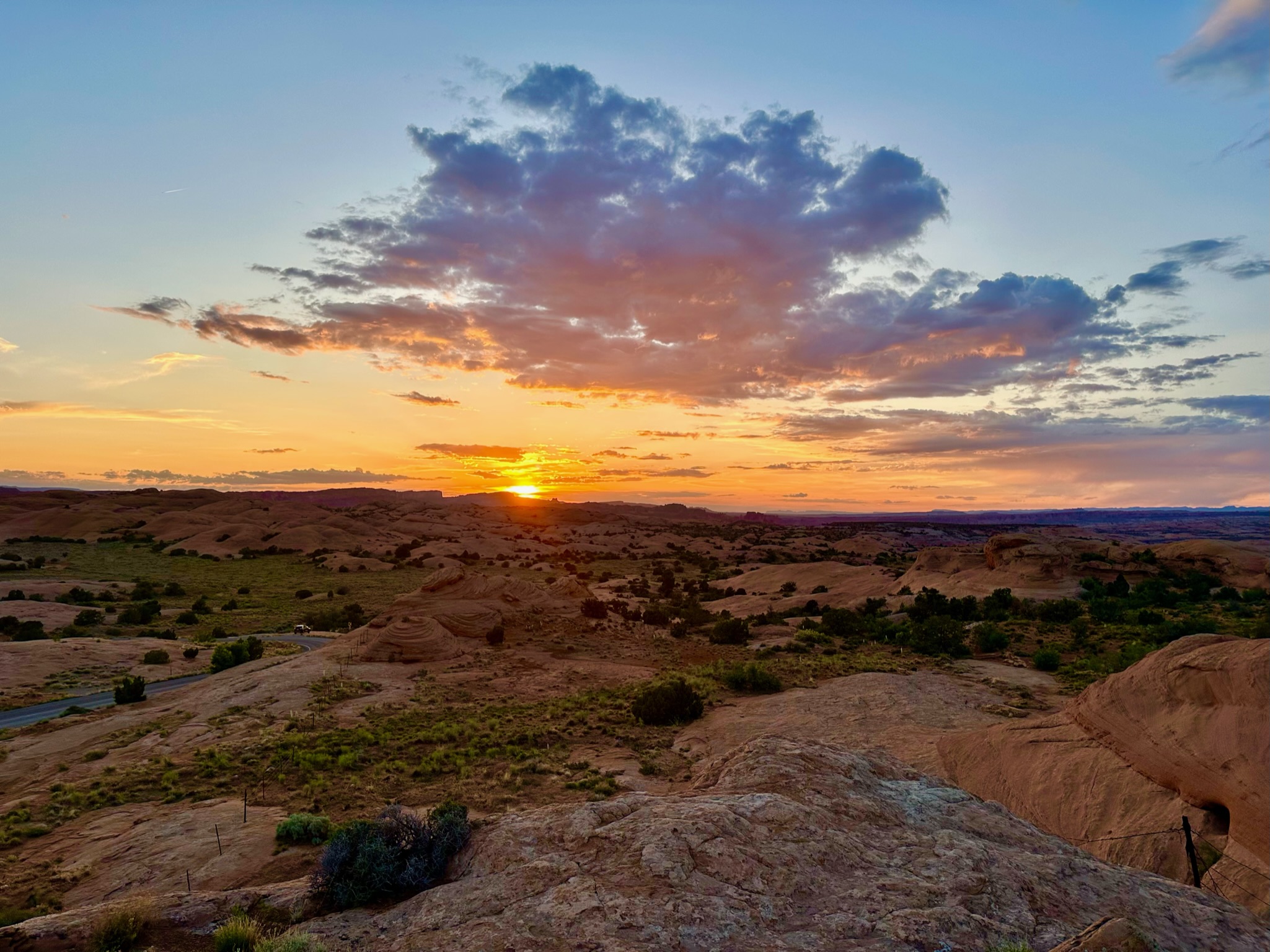
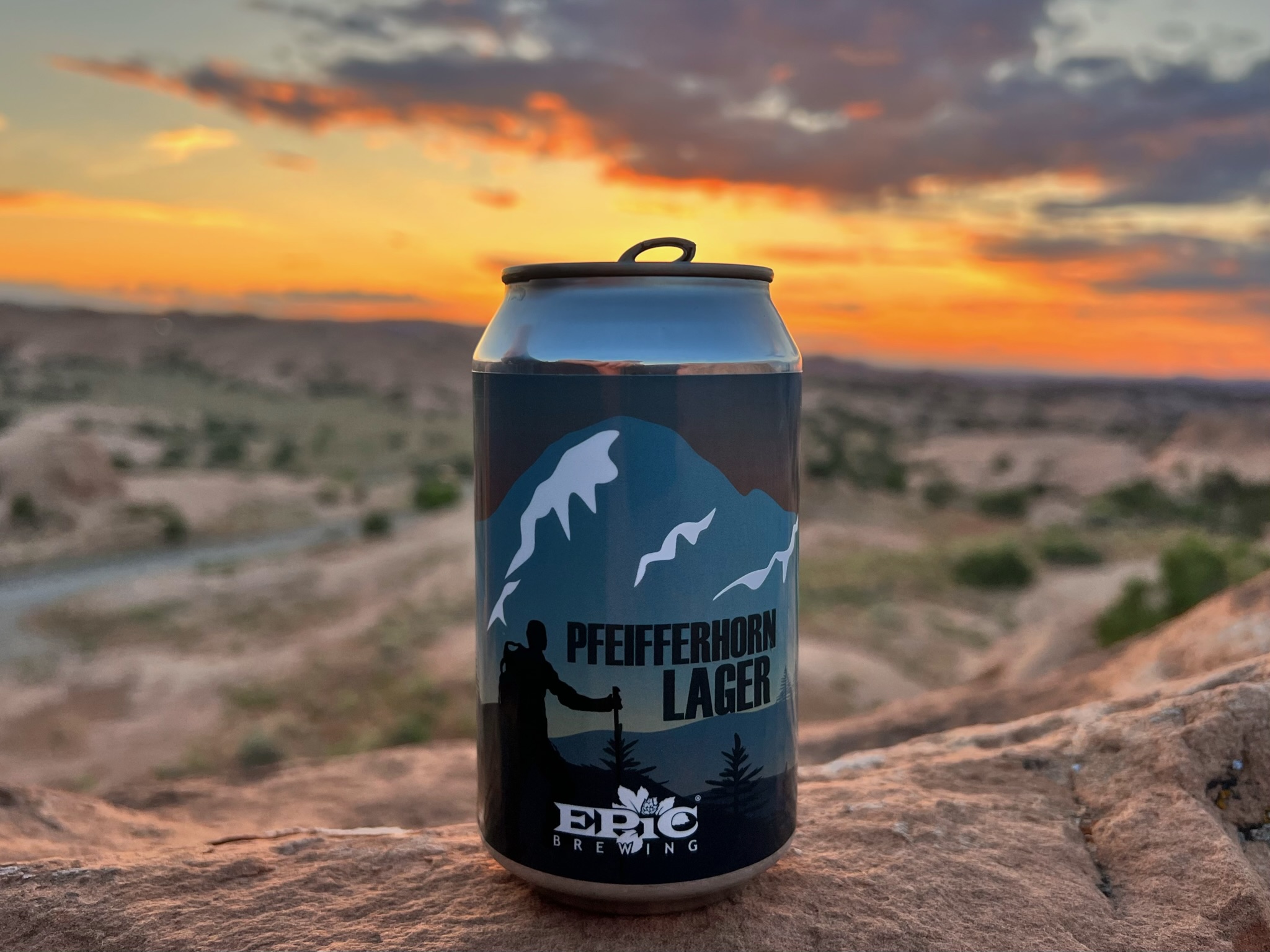
A great spot to catch the sunset in Moab is located outside town on the rocks overlooking the Slickrock trails. Although it may not have been considered a spectacular sunset by some, it’s a lovely spot to relax with a beer, enjoy the sunset, and chat about our upcoming plans for the morning.
“putting the can back in Canyonlands” – Photo by Rich, slogan by Bryan !
This is the eulogy I gave at the church service after my mother’s funeral – I’m posting it here to ensure there’s a digital copy for her children and grandchildren. The funeral was held on Friday, 11th November 2022, at Margam Crematorium, and the church service was at Skewen Methodist Church – the church that was a big part of her life for the last ten years.
Brenda Ford, formerly Sharples, nee Hawkridge
May 25th 1942 – October 19th 2022
Over the last few weeks, I’ve spent a decent amount of time thinking about who my mother was. While that may sound strange, as I’ve known her all my life, we only get to reflect on the full life of someone at a time like this. I’m sure we all have stories, memories, and ideas of who Brenda Ford, formerly Sharples, née Hawkridge, was, and I would love to hear yours, but first, let me take a few moments to share mine.
My mother was born in the small town of Elland in West Yorkshire in 1942 – right bang in the middle of the second world war. Her father (Ernie) was in the Royal Engineers and absent for much of her early life repairing bridges in Holland. She was a proud Yorkshire lass from the day she was born until the day she died. She liked her tea strong, was very down to earth, and would never shy away from sharing her honest opinion, and despite her diminutive frame, she could more than hold her own. Working the Friday night shift in Manchester Royal Infirmary was good preparation for dealing with a couple of unruly teenagers like me and my brother Rob. And I’m speaking from personal experience here – she would not hesitate to give us a good “clattering” if we stepped too far out of line.
In 1963 at the age of 21, my mother married my father, James Sharples, and a year later, she became a registered nurse and, a year after that – a mother for the first time. Over the next 40 years, she worked in large busy hospitals in Manchester, Oldham, and Lincoln and small family practices all over the country – wherever my Father’s Royal Air Force postings took us.
As well as working full-time – she was often a single mother of two young kids, as my Father’s work frequently took him away from home for long periods. Then, every four years or so, we would get uprooted and redeployed – we lived all over the country and overseas several times. Despite that constant upheaval and disruption – my mother’s resilience, genuine warmth, and easy-going nature always meant friends surrounded us. Engaging with people came easily, and she quickly turned strangers into friends.
At the end of the 1970s, after living in Yorkshire, Lancashire, Lincolnshire, Berkshire, Malta, Cyprus, Berkshire again, and then Norfolk – my parents finally settled in Wiltshire. This move was an opportunity to be close to my mother’s family – brother Graham, his wife Beryl, their kids Pip and Anthony and my mother’s parents. We even lived in the same street for several years – demonstrating how important family was to my mother. I still remember the 1977 Queen’s Jubilee – like many of you, we had a street party, and all 3 generations of my entire family were there – we were very fortunate kids.
My other endearing memory from my childhood was the family holidays and day trips – camping in the lake district during the hottest summer on record and arranging family lunch in Cardiff on the same day as an international rugby game. The intent was good – the planning, not so much. She also made it out to California twice and North Carolina to visit my family and me. She was never one to shy away from an adventure.
As well as a long career as a professional nurse – my mother was always willing to care for those around her. She nursed my brother and me through countless illnesses, bumps, bruises, and breakages. Later in life – she looked after my paternal grandfather (Thomas) and maternal grandparents (Ernie and Ivy), then later – my father when he was diagnosed with terminal cancer, and more recently, her second husband, John Ford, when he succumbed to dementia.
My mother married John Ford in 2013, having moved to Skewen in 2012. They both enjoyed being part of this community and church and gave up some of their time to make it the welcoming place it is today. I would try and call my mother once a week – though admittedly, I didn’t always manage that, but when I did, she would, no doubt, mention her various church groups and friends, so it was clearly a huge part of her life.
So, in the coming days, weeks, and months when you remember my mother, Brenda, don’t be sad. Instead, remember the young girl from a small town in West Yorkshire who never could have imagined the long life before her. The places she’d live and visit, the things she would do, the adventures she’d embark on, and the friends she would make along the way. Remember the woman who lived an honest and long life of service to others as a nurse, carer, wife, mother, grandmother, and church member. A long life with no regrets and countless fond memories spent with friends and family is probably the most any of us could hope for.
Finally, I would like to thank you all, on behalf of our family, for being here today and for being an essential part of her life.
Without interoperability, there is no #metaverse. Without open standards and open source and the resulting interoperability – there would be no Web or Internet as we know them today. It is no accident that the characters comprising this post are readable in any browser on any device and have been transported across the global network through various switches, routers, and proxies manufactured by different vendors. The reader doesn’t have to care or know which tool I used to create this post, nor which character encoding or font I prefer – that is all transparent to the user because of open standards like HTML, CSS, HTTP, and TCP/IP.
As the web evolves – standardization and interoperability will play an increasingly important role. The Metaverse is more ambitious than the current web regarding the sheer amount of technology involved. The Metaverse is an amalgamation of technologies from gaming, film, AR/VR, AI/ML, commerce, etc. Some of these areas have established standards; others are still nascent.
One of the critical areas of interop (according to a poll at the Metaverse Standards Forum) is the exchange of assets. This is required for seamless commerce, moving digital goods between assets, and choosing different tools at the design stage. Designers also need the ability to import assets into a virtual world from a film or game studio or real world without losing fidelity.
There are already two major standards in this area – USD (Universal Scene Description) – first developed by Pixar and open-sourced in 2016. Today it enjoys strong support from Autodesk, Apple, NVIDIA, and the open source blender 3D graphics application. NVIDIA goes as far as claiming that USD is the HTML of the Metaverse – more here.
If USD is the HTML for the Metaverse, then maybe the other standard – glTF (GL Transmission Format) is what JPEG is for the Web and Mobile today. glTF is a lightweight file format for describing 3D scenes and models and is widely supported by @Microsoft, Meta/Occulus, and Unreal Engine.
Each standard has its benefits and supporting ecosystem, and it may not be possible or necessary to arrive at a single standard to meet all needs. Queue joke about the need for a 3rd standard to rule them all!
What this illustrates is that for something as central as being able to describe a 3D scene or object – the Metaverse will likely have to support (at least) two significant standards along with the overhead and complexity of versioning, converters, extensions, importers, and translators to ensure assets can be moved between ecosystems without exposing the problem to end users.
The efficient and seamless interchange of 3D assets is just the tip of the iceberg, and interoperability in many other areas (security, identity, money, reputation) will have to be addressed before the Metaverse becomes a reality.
An aggressive cancer diagnosis in May 2018 got me thinking about my health more generally and specifically the importance of sleep in maintaining a healthy mind and body. I’m on my 3rd re-read (listen actually) of Matthew Walker’s, Why We Sleep, Unlocking the Power of Sleep and Dreams in which the author makes a pretty convincing case that sleep is everything and that with good sleep habits you will live longer, smarter and happier. If you haven’t read it and are interested in health you should check it out.
My cancer was deemed aggressive and so in consultation with a surgeon, two oncologists, a radiation oncologist and my wife – we decided to treat it aggressively. Over the last six months I’ve had surgery (prostate and lymph nodes removed), a two month course of radiotherapy and currently 4 months into 24 months of hormone therapy. Cut, burn, poison – they’re the current options when it comes to cancer treatment. That said, I believe a healthy diet, exercise and good sleep will have a big impact on my recovery and longevity. Hence the current interest in sleep.
Like most people – I’ve never really thought too much about sleep. You just sort of get on with it and battle on with what sleep you manage to get – your body lets you know when you don’t get enough and compensates to make it up . But travel, stress, illness, environment, diet can all have a short or long-term impact on your sleep and it’s more likely you just fall further into sleep debt.
After trying a few apps. on the Apple Watch (more on this in another post) I came to the conclusion that the poor battery life and form factor just weren’t working. While I love the Apple Watch for many reasons- the battery life sucks and I just can’t get used to sleeping with it on.
So prompted by a friend I took a look at the Oura Ring sleep / health / wellness tracker. The Oura ring is on it’s second generation and the first thing you notice is what a remarkable job they’ve done jamming a lot of technology into a small space – 3d accelerometer and gyroscope, body temperature sensor, infrared LEDs, battery and BLE radio.
As you can see in the picture – It’s only slightly thicker than my platinum wedding band and a little bit lighter (titanium and plastic). I ordered size 10 but I’m probably a 9.5 so it’s a little loose but I erred on the bigger size assuming my fingers will swell in the summer. Oura have done a good job with the design – quite a few different finishes and styles – I chose the Heritage Stealth (matt-black). It’s waterproof and fairly scratch resistant so you can put it on a forget about it. The battery lasts about a week and only takes 20 mins to charge and uses a wireless charger (included). There is an airplane mode which turns off the BTE radio and that pushes battery life to about 11 days – but you have to remember to put it on the charger to re-enable it and upload data – so sorta defeats the purpose IMO.
The ring tracks a number of sleep metrics :
Resting Heart Rate (RHR)
Heart Rate Variability (HRV)
Body Temperature
Respiratory Rate
Activity
The first four of these are used to determine how much time you spend in different parts of the sleep cycle and gives you an overall Readiness Score. Activity track, as you might expect – activity – it’s not really a dedicated activity tracker and from my experience the step and calorie tracking is pretty inaccurate compared to my Apple Watch.
Right now I’m really just interested in the overall score and duration of my sleep but will likely at some point dig a bit deeper into things like HRV and body temperature – especially when I get back to cycling.
The ring comes with a pretty decent app (I’ve only tried the iOS version) that basically derives the readiness score and presents last nights sleep as well as overall trends.
The key part for me is the duration of each element of the sleep cycle. REM and Deep sleep are the most important to overall health and recovery. Resting Heart Rate is a good indicator of general aerobic health. Everyone is different and it’s key to focus on the trends and not the absolutes.
At this point (now you can see the charts) – it’s worth pointing out that my sleep right now is really poor – these are the effects of my aforementioned cancer treatment – I wake up 2-3 times a night for a bio break. But already I can see some improvements and I’m able to experiment with different sleep aids, bedtime routines and eventually impact of exercise (when I’m recovered enough).
So far – after about a month – I’m pretty impressed with Oura – I certainly have some suggestions for improvements in the app – more on that when I get time to write about my comparisons with other Apple Watch sleep trackers. Until then :
After 5 days of riding, Jack and I still had a bit more ride left in us – our fellow explorers decided to try something different for the day but we were determined to make the most of what Moab has to offer in the shredding department. Our RimTours guides recommended a couple of local rides. The HyMasa / Captain Ahab and the Mag 7 seemed like the best options and we chose Captain Ahab because Jack thought we really needed to do a double black diamond after five hard days of riding and I’m an irresponsible father.
We re-rented the same bikes we’d been using for the last four days and were dropped at the start of HyMasa by David – one of our Raleigh compadres. It was around 10am and already fairly busy (probably due to OuterBike).
HyMasa is a slow 3 mile grind on a mixture of rock and dirt and is mostly pretty straight forward but you have to keep moving to ascend the numerous rock steps that take you up to the start of Captain Ahab. This really is some of the best mountain biking I’ve ever experienced – slow going but fulfilling.
On the way up my son and I passed a pivotal moment in our father son relationship – given his superior fitness going uphill and fearlessness going downhill – he became the leader; and me the follower. Of course he didn’t notice – he was too busy racing some of the local hammerheads to the top of the mountain.
After you’ve enjoyed the amazing view you start the Capt. Ahab descent – it’s all very technical though most of the big drops have an alternative line so you can make the ride as hard or easy as you want – there were only a couple of places we had to dismount and walk. But this really is a very technical and unforgiving trail – if you take a fall you’re going to get hurt and you’re a long way from anywhere – I never ride in knee or elbow pads but would definitely do that next time. Jack came off twice and was lucky to only loose some skin – we slowed our pace after the second tumble.
When we got back to the parking lot (after a short traffic jam due to 4 wheelers) the mountain rescue team were heading into HyMasa with a stretcher – a rider had fallen and broken his arm (compound fracture) – a good reminder that while this is some of the best MTBing on the planet – it’s not without it’s risks.
This is a trail I would definitely ride again – with fresh legs and some armor it would be a blast !
After the evening’s star, satellite and ISS spotting we woke to a beautiful calm and clear morning. Being next to the Green River where there’s a little more moisture – we got a mild frost and the Sun took a little longer to rise over the surrounding mesas but once it did we had coffee and a decent last day breakfast in the (relatively) warm morning sun.
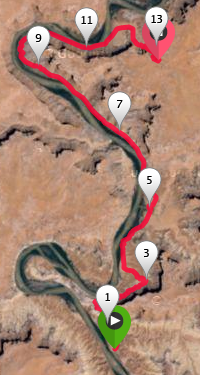
First task of the day was to reclaim all the height we lost tearing down Murphy’s with a tough couple of climbs straight out of the camp (Hardscrabble) – no chance to warm up the legs or lungs.
The next 7 or 8 miles along the Green River were mostly flat and fast with some interesting stops on the way to view some old Anasazi Indian ruins and artifacts the guides had discovered over the years.
Between us a lunch was our final and toughest climb of the week – Horsethief Bottom up to the Island in The Sky – it’s not technically hard – just soul crushing as the alpine-style switchbacks seem to go on forever. The kids practically sprinted up leaving many of the adults in the dust. My plan was to start last and attack from the back – I didn’t quite pull off the second part of that strategy ;(
Our ride finished with another great lunch in the parking lot at the top of the climb – more stunning views and a great place for some group pictures. But there’s more …




















 Rich Sharples' Weblog